Category Archives: Insects

Friends of the Garden, Part II

June 5, 2023

14 Fascinating Facts About Ladybugs

(These are excerpts from a story by Rosemary Mosco and orginially published on mentalfloss.com and updated for 2023)

  1. Ladybugs are named after the Blessed Virgin Mary.

One of the most common European Ladybugs is the seven-spot ladybug, and its seven marks reminded people of the Virgin Mary’s seven sorrows.  Germans even call these insects Marienkäfers, or Mary’s beetles.

  1. They are not bugs!

Ladybugs are not bugs – they are beetles.  They are part of Coleonptera, the beetle order.  

  1. Some people call ladybugs birds, bishops, or cows.

In parts of England, and for reasons that are unclear, the ladybug is a bishop.  Nowadays, most people in England use the word ladybird, perhaps because these insects are able flyers. 

In several languages, the portly, spotted ladybug is affectionately known as a little cow.  French people sometimes use the term vache à Dieu, which means “cow of God”.

  1. Ladybugs come in a rainbow of colors.

You’ve probably seen red ladybugs with black spots – but members of the ladybug family come in a wide range of hues, from ashy gray to dull brown to metallic blue.  Their patterns vary, too; some have stripes, some have squiggles, and some have no pattern at all.

  1. Those colors are warning signs.

To avoid being eaten, ladybug species with bright colors are walking billboards that say, “Don’t eat me, I’ll make you sick!”  And that is because…

  1. Ladybugs defend themselves with toxic chemicals.

A lot of ladybugs produce toxins that make them distasteful to birds and other would-be predators.  These noxious substances are linked to a ladybug’s color, the brighter the ladybug, the stronger the toxins.  Don’t panic:  Ladybugs won’t harm you unless you eat many pounds of them!

  1. They lay extra eggs as a snack for their young.
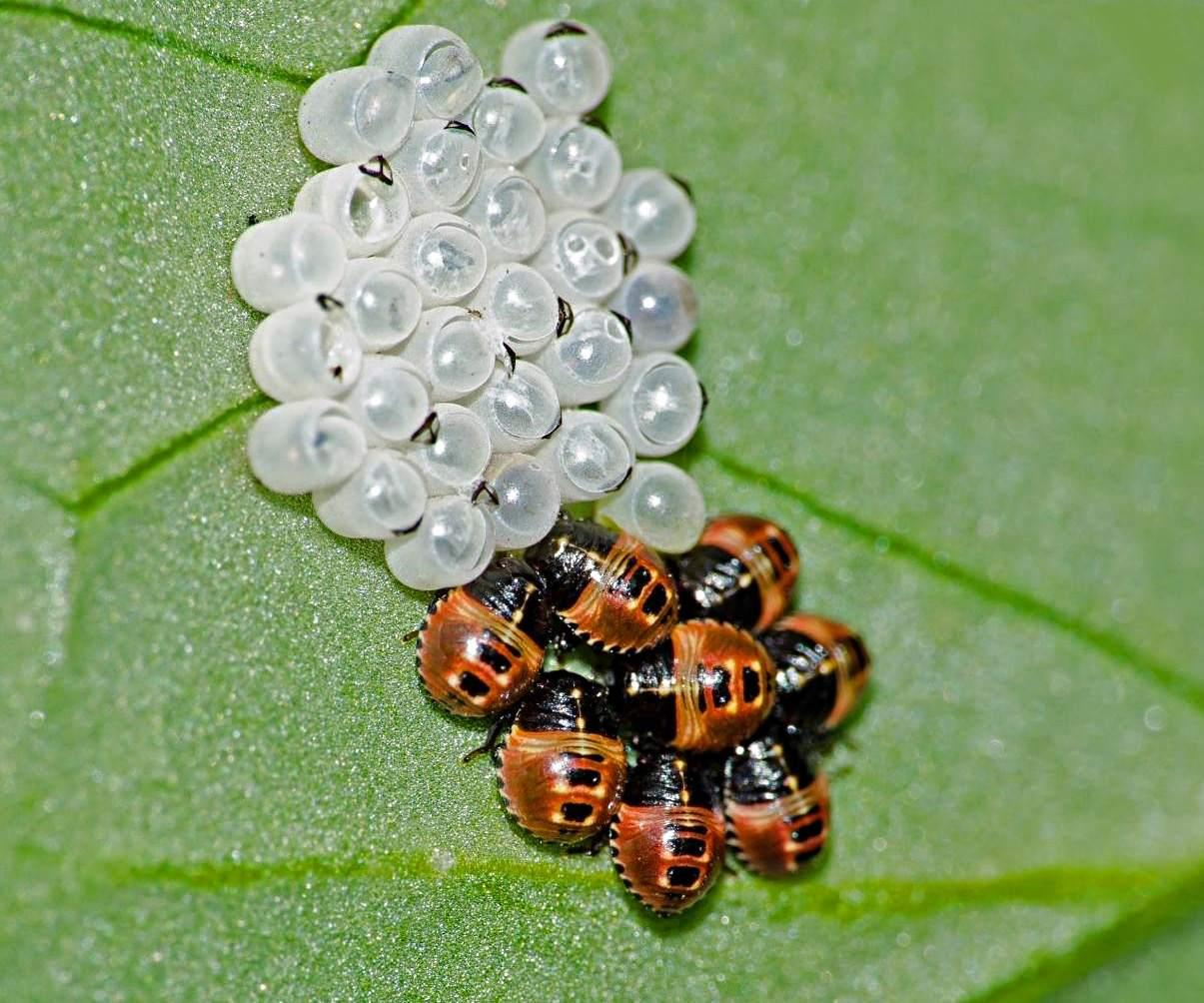
Ladybug moms lay clusters of eggs on a plant, but not all of those eggs are destined to hatch.  Some of them lack embryos.  They’re a tasty gift from the mother ladybug; the newly hatched larvae will gooble them up.

  1. Ladybug larvae look like alligators.

What hatches out of those ladybug eggs is a long, spiny larva that looks a little like an alligator.  Though ladybug larvae may be intimidating, they’re not harmful to humans.  They crawl around, feeding and growing, until they’re ready to turn into something even weirder…

  1. Ladybug pupae look like aliens.

Once the larvae find a nice spot in the garden, they turn into an alien-looking pupa.  Protected by a hard covering, the ladybug then makes an incredible transformation from larva to adult, bursting out of its old skin.

  1.  Adult ladybugs fly with hidden wings.

When a ladybug takes flight, it lifts up its protective, hard covered wings, that are not suitable for flight, and slides out another pair of wings that are light weight, slender and perfect for flight.

  1. Ladybugs survive the winter as adults.

They enter a state of rest and cuddle together in groups, often in logs or under leaves.  Some even find comfort in our homes, the harlequin ladybug enjoys the warmth that is provided.

  1. They’re voracious predators – mostly.

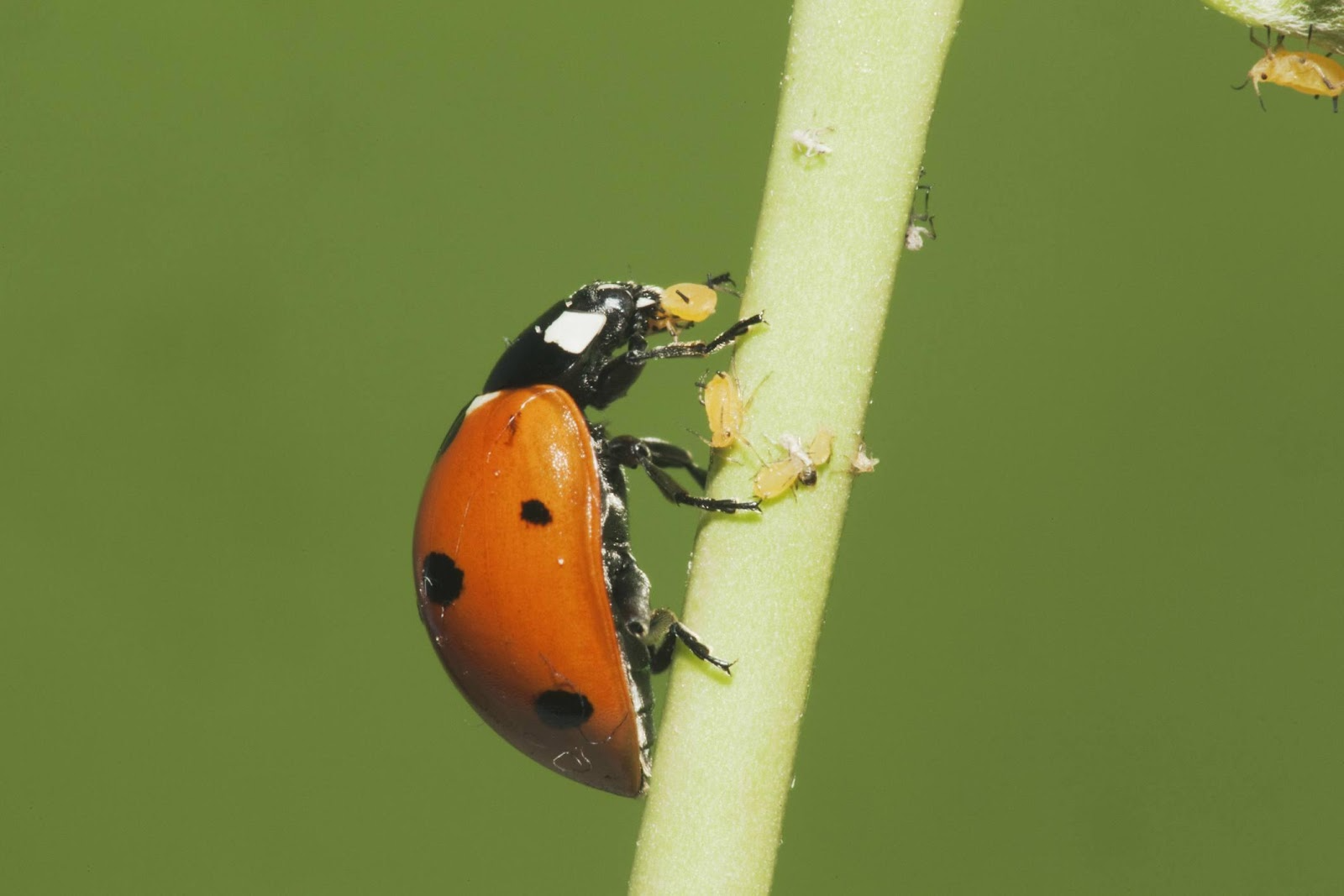
They are a natural form of pest control.  They’re favorite foods are some of our worst plant pests:  aphids, scale bugs, and mealybugs.  A single ladybug can eat 5000 aphids across its lifetime.

  1. Humans are spreading ladybug species around the world.

People have introduced non-native ladybugs to combat agricultural pests, and in some cases they’ve hitchhiked on imported goods.  The results have not always been beneficial as they push out the native species and introduce a deadly fungal parasite.

  1. They can be bad for your wine.

After devouring the aphids on nearby crops, such as soybeans, if vineyards are nearby, the ladybugs take up residence in bunches of grapes.  When ladybugs become frightened during harvesting, they squirt out a smelly defensive liquid fluid.  The resulting wine has a particular stinky flavor that has been likened to peanuts or asparagus.

There are additional sources on the use of beneficial insects at: 

 www.aggies-horticulture.tamu.edu/vegetable/problem-solver

Jon Maxwell, Dallas County Master Gardener
Feed the Bees…A Smorgasbord of Plants for Zone 8

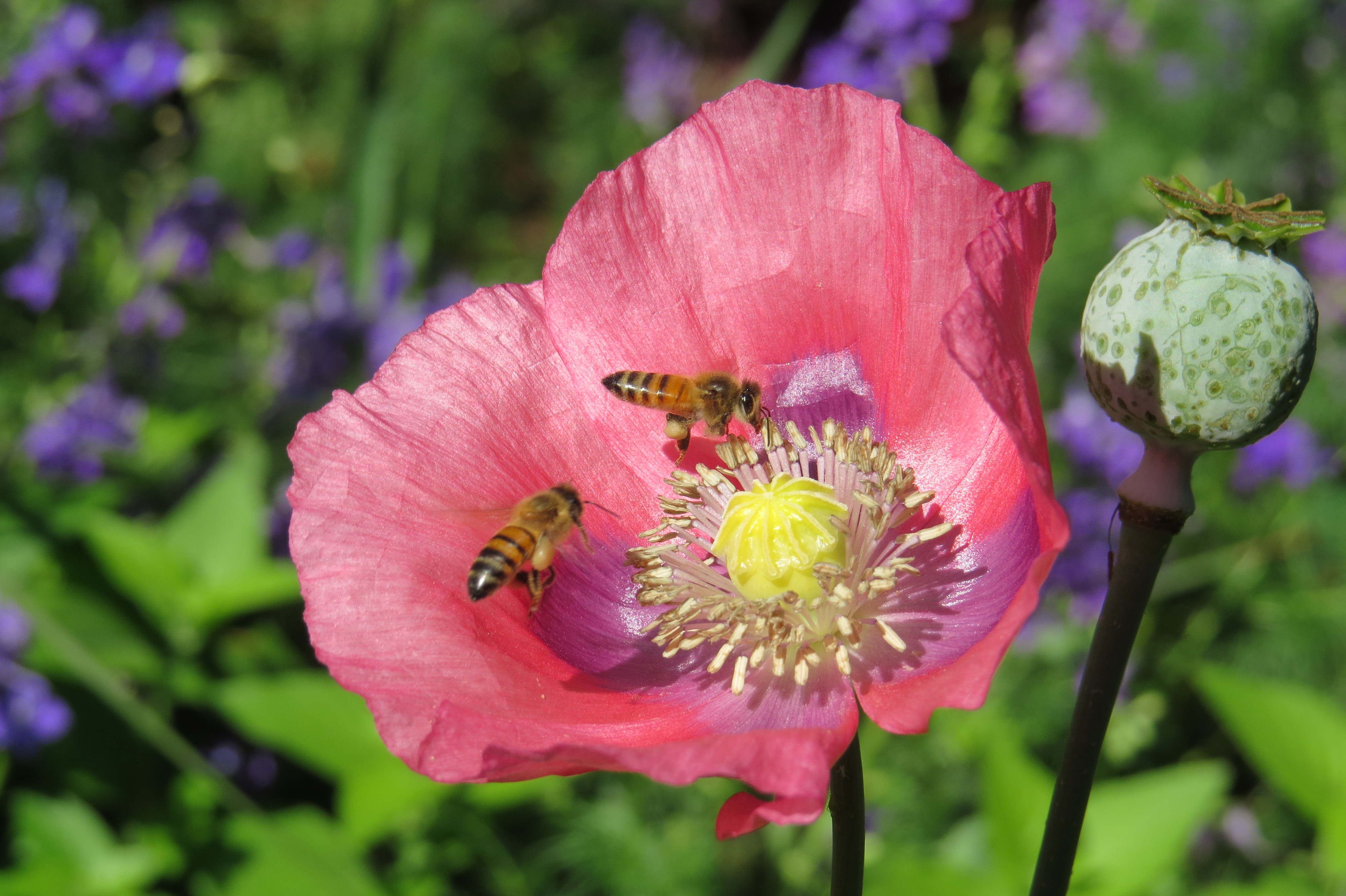
Bees require both nectar and pollen sources for survival. Each source has a specific purpose, nectar for energy and pollen for protein. Let’s do our part by offering them blooming plants throughout the seasons and help to avoid a feast or famine situation for the bees. Included in this post is a partial listing of nectar and pollen sources along with photos of seasonal plants loved by honeybees. Be proactive and intentionally plant flowers that bloom at different times of the year.

Annuals

*Alyssum

*Basil (especially African Blue and Cinnamon)

*Cockscomb

*Fuchsia

*Larkspur

*Love-in-a-Mist

*Mexican Sunflower 

*Moss Rose

*Snapdragon

*Stock

*Sweet Pea

*Zinnia

Perennials

*Anise Hyssop

*Fall Aster

*Borage

*Clovers

*Columbine

*Chrysanthemums

*Scented Geranium

*Lambs Ear

*Lavender

*Mallows

*Scabiosa

*Shrimp Plant

*Statice

Vines

*Black-eyed Susan Vine

*Cantaloupe

*Clematis

*Cucumber

*Gourds

*Honeysuckle

*Jasmine

*Morning Glory

*Passionflower

*Pumpkin

*Squash

Shrubs

*Azalea

*Barberry

*American Beautyberry

*Boxwood

*Butterfly Bush

*Cherry Laurel

*Cotoneaster

*Crepe Myrtle

*Fire Thorn

*Flowering Quince

*Hydrangea

*Spirea

*Viburnum 

*Weigela

*Wisteria

Linda Alexander, Dallas County Master Gardener Class of 2008

Pictures by Starla Willis, Dallas County Master Gardener Class of 2009

Friends of the Garden

Many of you have seen these color change artists in your own gardens but do you really know what they are and how they help to limit plant pests?

The green anole, Anolis carolinensis, is a small to medium-sized lizard, with a slender body and a long tail.  Its head is elongated and has numerous ridges between its eyes and nostrils, and smaller ones on the top of its head.  Its toes have adhesive pads to facilitate climbing.  The males are 15% larger than the females, and the male dewlap (throat fan) is three times the size of the female’s and ranges in color from bright orange to a light pink, whereas the females dewlap is lighter in color.  The extension of the dewlap from the throat is used for communications.  Males can also form a dorsal ridge behind the head when displaying or when under stress.

The green anole’s body coloration can vary from dark brown to bright green and can be changed like many other kinds of lizards, but anoles are closely related to iguanas and are not true chameleons.  The anole changes it color depending on mood, level of stress, activity level and as a social signal, (for example, displaying dominance).  Although often claimed, evidence does not support that they do it in response to the color of their background.

Ever seen one with either no tail or a very short one? An interesting fact is that the anole, like many lizards, has an autotomic tail, which will wiggle when broken off to distract a predator and allow the anole to escape.

This species is native to North America, where it is found mainly in the subtropical parts of the continent.

An anole’s diet consists primarily of small insects such as crickets, grasshoppers, flies, moths, cockroaches, small beetles, and other arthropods, including spiders, as well as occasionally feeding on various mollusks, (think snails and slugs), grains and seeds.

Jon Maxwell, Dallas County Master Gardener

Creating a Smorgasbord for the Bees

In a recent article from gardenbetty.com, Linda Ly listed the best flowers to grow for bees. She identified them as the ‘Foolproof Five’. Much to my delight, I’ve been growing each of them for many years and agree with her that they are seasonal favorites for the bees. They can be found growing in my raised beds, in containers and in ground when more space is needed. Most of them receive at least four to five hours of morning to early afternoon sun and then dappled shade for the remainder of the day. Before sharing the list, let’s answer a few very important questions: 

Do the colors of the flowers make a difference when attracting pollinators? 

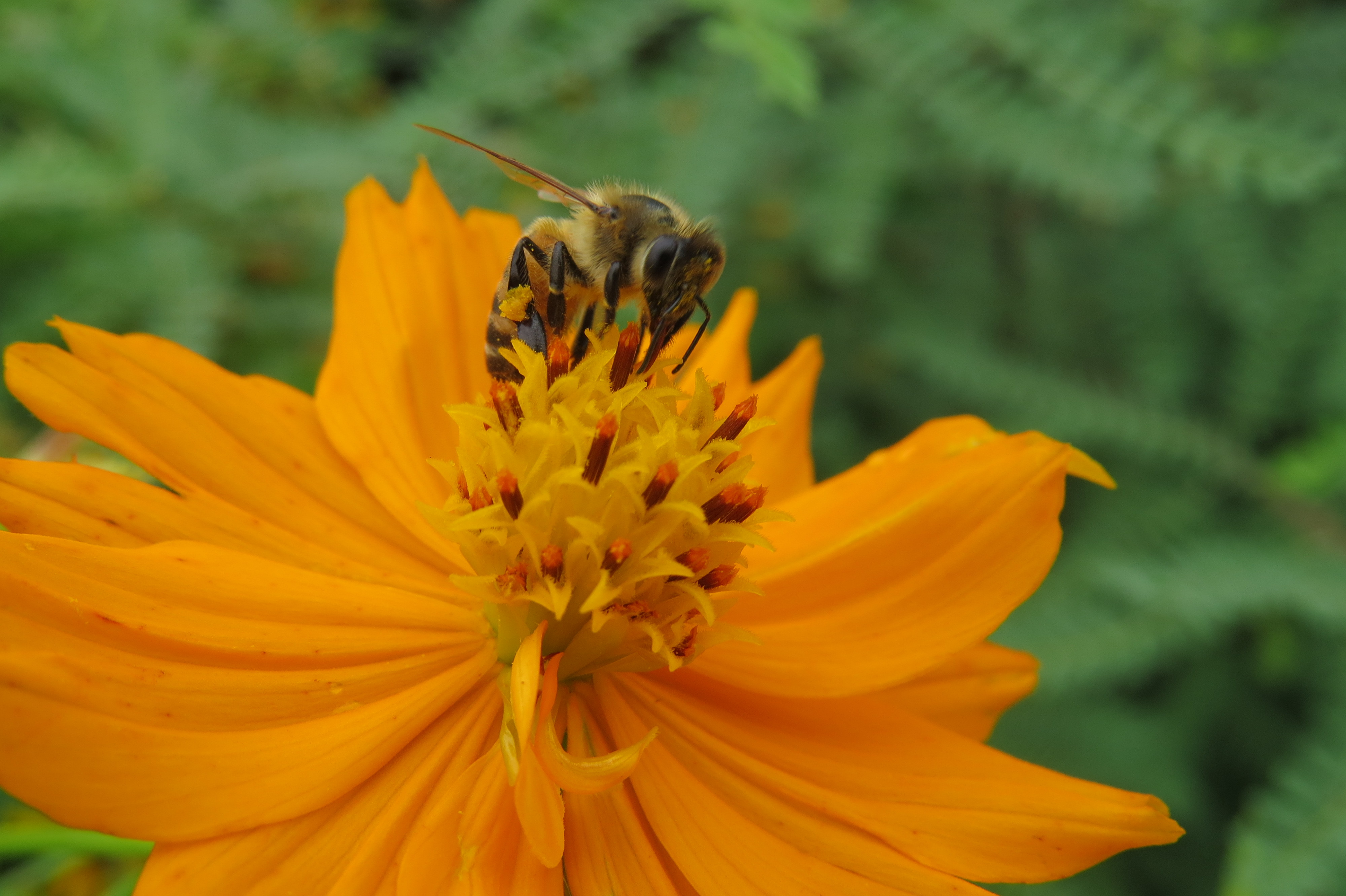
Bees have amazing eyesight which gives them the ability to see color much faster than humans. Their color vision is the fastest in the animal world – five times faster than humans. Every bee has two large compound eyes and three ocelli giving them trichromatic eyesight. Humans base their color combinations on red, blue and green while bees base their colors on ultraviolet light, blue and green. 

Bees cannot see the color red, but they can see reddish wavelengths such as yellow and orange. They can also see blue-green, blue, violet and “bee’s purple”, a combination of yellow and ultraviolet light. According to scientific studies, the most likely colors to attract bees are purple, violet and blue. Yellow is also a favorite color for bees. Dark colors like red, brown and black make them aggressive.

What is it about the color blue that bees love?

The simple answer is that flowers in the violet-blue range produce the highest volumes of nectar. Herbaceous plants, shrubs and trees generate a blue or (UV) ultraviolet scattering effect. Since bees see blue spectrum colors best, their foraging trips often take them to their preferred nectar-and-pollen-rich plants within this range.

Is color the only deciding factor for bees to select flowers?

Bees do not depend upon color for identifying flowers to collect pollen and nectar. For bees, flowers are identified by shape more than the bright color. Simple flower shapes with easily accessible centers are most desirable. Single flowers with open petals are a bee favorite.

Flat flowers that they can land and walk on are also preferred.

If you’re ready to start planting, here’s a look at the top five:

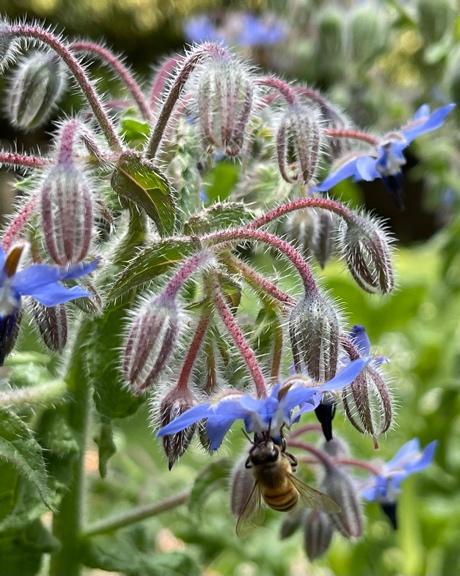
Borage (Borago officinalis)

A bee on a purple flower

Description automatically generated with medium confidence

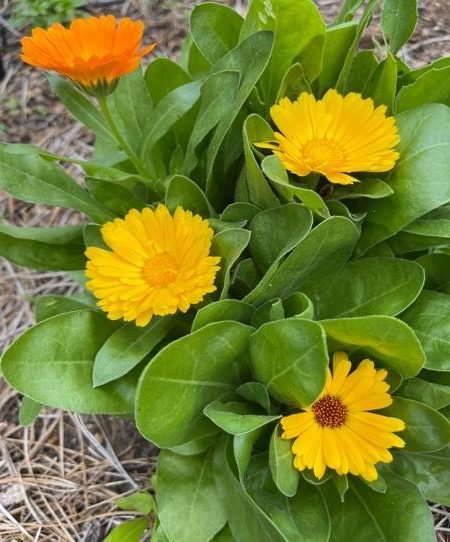
Calendula (Calendula officinalis)

Coneflower (Echinacea spp.)

Milkweed (Asclepias)

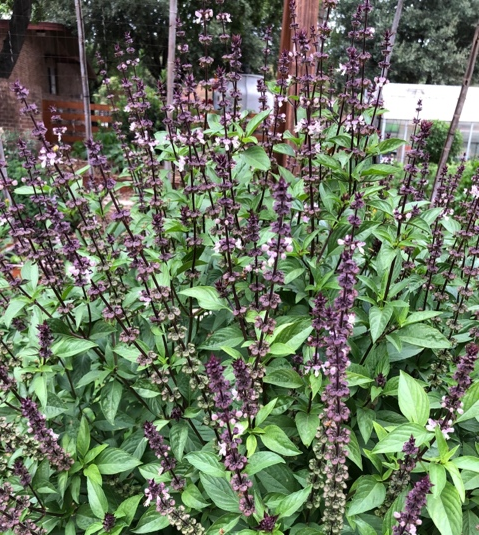
Mint Family (Lamiaceae) Basil, Lavender, Varieties of Mint, Oregano, Salvia, Thyme and More

A picture containing outdoor, plant, vegetable

Description automatically generated

For more information, including a lengthy list of flowers, herbs shrubs and trees for attracting pollinators go to:  https://aggie-horticulture.tamu.edu and type in Central Texas Bee-Friendly Plants – Texas A&M University

For a yummy and colorful honey treat try Yogurt Parfait with Thyme Honey and Fruit. Serve it for breakfast, brunch or as a stunning dessert. Thyme honey is a variety of monofloral honey made from the nectar and pollen of thyme flowers. Its unique flavor profile and intense taste make it a beautiful compliment to the creaminess of the yogurt layered with crunchy bites of fresh fruit and granola. The collecting season for this highly aromatic honey is only a few weeks in the summer – from late June to August. 

Linda Alexander, Dallas County Master Gardener, Class of 2008

“Drops of Honey” …February Feature

Who can resist a heavenly chocolate experience on Valentine’s Day? Sweeten it up with Honey! Recipe below.

Understanding the Anatomy of a Honeybee

On October 19, 1909, the U.S. Department of Agriculture, Bureau of Entomology received a manuscript from Mr. R. E. Snodgrass, an agent and expert of the Bureau. It was entitled “The Anatomy of the Honeybee.” This exhaustive 150-page document was described as “embodying the results of detailed studies made by Mr. Snodgrass and should prove of value as bringing to the beekeeper reliable information concerning an insect of such great importance, and also as furnishing a sound basis in devising new and improved practical manipulations.” The brilliant work of Mr. Snodgrass is considered a valuable piece of work which has now been quoted and used continuously for over 100 years. 

In 1956, the work of Robert Snodgrass was published into book form. With over 350 pages, it is a classic work that is acclaimed as much for the author’s remarkably detailed line drawings of the various body parts and organs of his subject as his authoritative knowledge of entomology. Over the years,  it was suggested that his book should be in the library of every student of the honeybee and bee behavior. 

For the sake of brevity, and in the words of Mr. Snodgrass, here is a summary of the primary functions of the honeybee:

“It possesses mouth organs for taking up raw food, an alimentary canal to digest it, salivary glands to furnish a digestive liquid, a contractile heart to keep the blood in circulation, a respiratory system to furnish fresh oxygen and carry off waste gases, excretory organs for eliminating waste substances from the blood, a nervous system to regulate and control all the other parts, and, finally, organs to produce the reproductive elements from which new individuals are formed to take the places of those that die.”

And, just to think, this is the masterfully created tiny machine that gives us honey!

Now, let’s take a closer look at how this happens.

“Drops of Honey” …FebruaryClipart - New HeartFeature

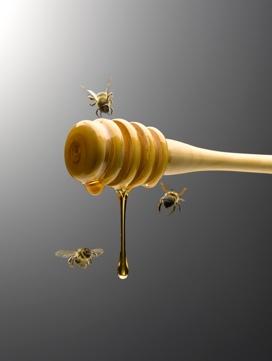
Honey dripping from spatula with honeybees around

What is honey and how is it made?

Scientifically speaking, honey is a complex carbohydrate composed of approximately 80 percent monosaccharides, or simple sugars, mostly fructose (levulose) and glucose (dextrose) in varying ratios depending on the nectar source. The remaining content, approximately 16-18 percent, is water. Fructose is slightly sweeter than glucose and, when it occurs in larger quantities than the glucose, can lead to rapid crystallization of the honey, 

Over twenty-five other disaccharides have been identified in honey along with oligosaccharides, including erlose, theanderose and panos. These are not naturally present in nectar but are formed during the honey ripening process.

One of the most important attributes of any honey is its water content. The average water content of most good-quality honeys is 17-18 percent. This happens because bees make it that way.

Yeast is also present in all honeys as a result of being in the environment in general. Proteins make up about twenty-five percent of honey composition with at least 19 different ones present. The proteins are mainly enzymes added by the bees during the ripening process. Invertase, the most significant enzyme is what sets honey apart from other sweeteners. 

Honey contains a few amino acids. The most important, of which, is proline. Some proline is derived from the plant source, and some added by the bees. Proline is the measure of honeys ripeness and is an important standard for judging quality and flavor profile. 

Gluconic acid is the most prominent acid found in honey. It adds flavor enhancing properties.

Honey contains a wide variety of minerals including potassium and trace elements. Worth noting, darker honeys are stronger in flavor due to their higher mineral content. Important also, is that these elements make it possible to identify different types of varietal honey. 

Finally, honey also contains over six hundred volatile organic compounds (VOC) or plant-based essential oils. Many originate from the plant and some are added by the bee. 

*Volatile organic compounds evaporate from honey when the honey is heated, therefore, heating honey compromises its delicate flavors.

In summary, let’s close with a few simple answers to the question, ‘what is honey’. 

*Honey is the essence of flowers. 

*Honey is a thick, golden liquid produced by industrious bees. 

*Honey is the result of a colony of bees working together to collect flower nectar and transform it into a high-energy source for the hive. 

*Honey is an organic, natural sugar alternative with no additives.

The A, Bee Cs of Honey Making

Honey production is a carefully orchestrated series of chemical processes including digestion, regurgitation, enzyme activity and evaporation. It is exclusively the creation of the female worker bees. Nectar, a sugary liquid, is extracted from flowers using a bee’s long tube-like tongue called a proboscis then stored in its stomach or “crop”. While sloshing around in the crop, the nectar mixes with the enzyme invertase which begins the transformation of its chemical composition and pH, making it more suitable for long-term storage. 

When a honeybee returns to the hive, it passes the nectar to another bee by regurgitating the liquid into the other bee’s mouth. This regurgitation process is repeated until the partially digested nectar is finally deposited into a honeycomb. 

Once in the comb, nectar is still a viscous liquid – nothing like the honey you use at home. To get all that extra water out of their honey, bees set to work fanning the honeycomb with their wings to speed up the process of evaporation. 

When most of the water has evaporated from the honeycomb, the bee seals the comb with a secretion of liquid from its abdomen, which eventually hardens into beeswax. Away from air and water, honey can be stored indefinitely, providing bees with the perfect food source for cold winter months.

Linda Alexander, Dallas County Master Gardener Class of 2008
Honey Chocolate Cake with Chocolate-Honey Icing and/or Honey Whipped Cream

From Junk Bug to Green Lacewing

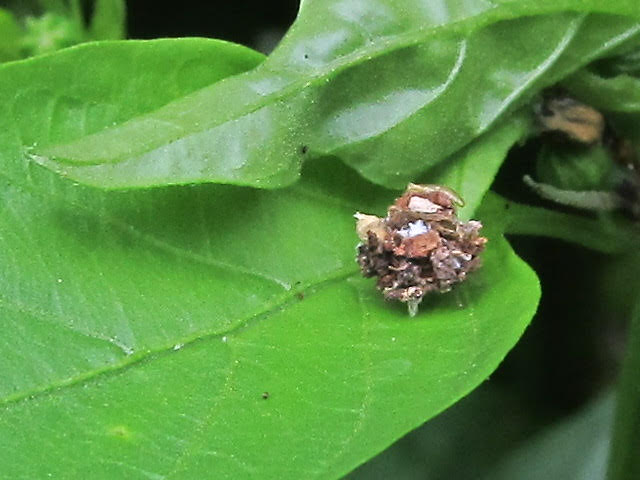
Diane, a frequent visitor to Raincatchers Garden, saw a little bit of debris on a leaf. To her surprise it began to move purposefully. She learned that the debris was called a junk bug. It covers itself with the bodies of insects it has preyed upon. This creates a convincing camouflage that fools birds and the ants that tend aphids. Aphids are a frequent snack.

Junk Bug with a purpose!

The junk bug is a larva that becomes a green lacewing, a beautiful insect with delicately veined gossamer wings.Per Diane, “I almost missed it till it started moving, and this is my very first one to ever see, or even hear of.”

Thanks, Diane, for your close observation. It’s great to know we have an insect ally to help us keep the aphids in check.

P.S. The eggs on a stalk shown in the picture above are also part of the lifecycle of this beneficial insect.

Beverly Allen, Dallas County Master Gardener Class of 2018

PIctures by Diane, a friend of The Raincatcher’s Garden

Crane Flies

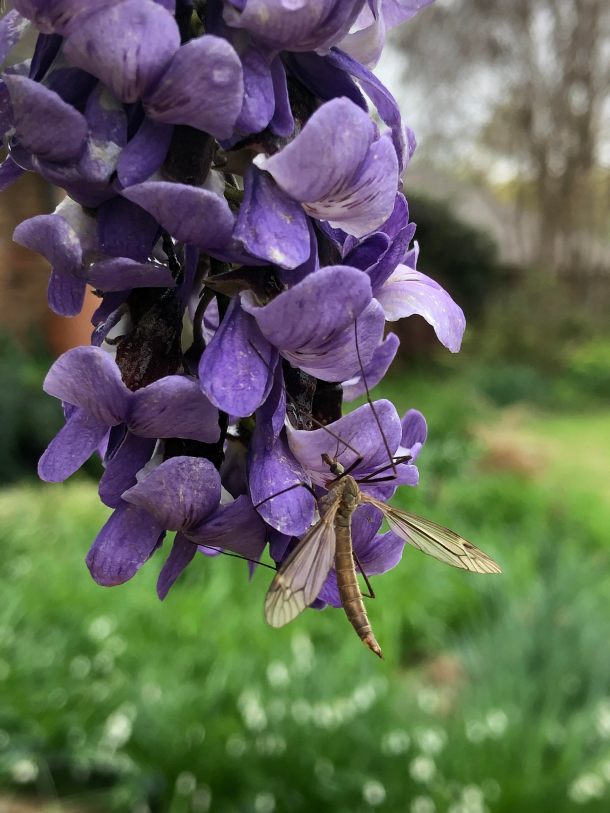
Have you noticed the plethora of winged insects with really long legs of late?  While admiring our blooming Texas Mountain Laurel, crane flies were spotted resting on the grape-soda scented flowers.  After taking way too many pictures, it was time to learn about them. We are seeing an abundance of them due to the wet weather and the fact that it’s early spring, the time they usually appear.  

There are over 14,000 species of Crane Flies.  “Mosquito Hawk” is the common name, which is a misnomer all the way around. It is not a mosquito, it’s a fly, and hawk nope, – not a predator, and it doesn’t hunt down mosquitoes either, but is often food for other birds and wildlife.  

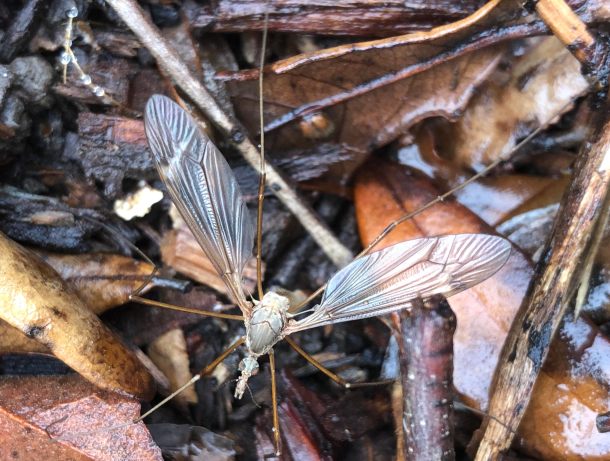
They have beautiful stained glass-like wings as seen in this up close photo

These beneficial insects contribute to the ecosystem by feeding on decomposing matter in moist areas in the larval stage, which is 95% of their life span. The crane fly’s lifecycle is about a year, but adults only live for about 10-15 days. They do not bite, are attracted to light, and the sole purpose as adults is to mate and for the female to lay eggs near water.

Enjoy the brief time that crane flies occupy our airspace.  They are interesting to watch, helpful to our environment, and fun to photograph. 

Starla Willis  


Dragonfly obelisk

Upended by the weather?

Dragonflies regulate body temperature in bright sunlight by doing a handstand. Entomologists refer to this upright dragonfly pose as the obelisk posture.

Thank you to the blog Portraits of Wildflowers.

Ann Lamb

Reminder that tickets went on sale this morning for the Pumpkins on Parade, Sweet Potatoes for Adornment event on October 22nd. Click here.

Picture by Steven Schwartzman of Portraits of Wildflowers.

Hanging Out At the Mall

      There are always problems with anthropomorphizing non-humans. Just think of those cute cat and dog “shaming” videos where animals are just being true to their nature but we humans attach reasons and feelings behind their behavior.  Still sometimes, even insects seem to display some “human” characteristics.

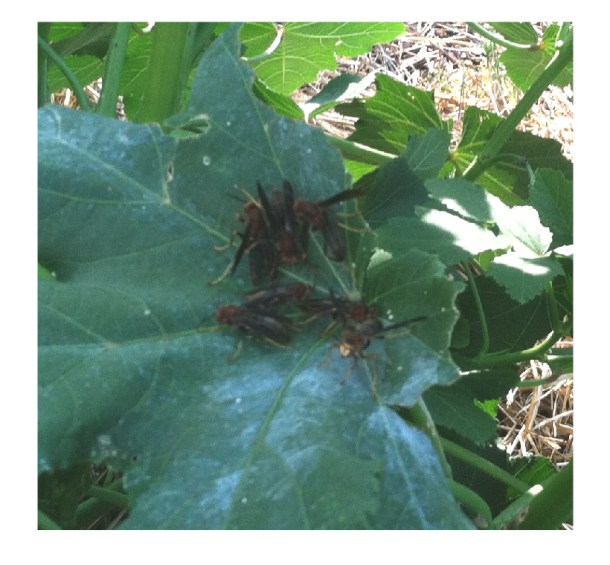
I thought about this a few years ago in autumn when I was picking the last of the okra.   Though an occasional brown paper wasp was often seen in the garden, suddenly, as I was disturbing the plants, I was surrounded by more than one wasp.  As they did not seem particularly aggressive, I kept on picking.  However, when the same thing happened the next day, I began to look more closely at the okra plants.  There to my horror were two clusters of about seven or more wasps on the underside of two leaves.  After getting over my shock, I began to observe their behavior.

wasps2

Every once in a while a new wasp would fly into the group.  The other wasps would rush to the “newcomer” and start feeling its body with their antennae.  At first I wondered whether the original group was trying to kill the newcomer, but realized that perhaps this was their way of communicating.  What was going on?

A quick Google search revealed that the behavior was common.  Stephen Bambara and Michael Waldvogel, Extension Entomologists with North Carolina Cooperative Extension say: “… paper wasps show types of swarming behavior during the cool and cold times of the year when there are no nests and no young larvae to protect.  During the fall, this behavior is connected with mating and is the wasp version of “boy meets girl.”  Male wasps look for the best place to “hang out” and attract females.  On these warm days during the fall, the future queens become active and fly about.  Dozens or hundreds might be seen around the upper stories of a building, transmission tower or other tall structures.” Were the male wasps that I was observing just acting like teenage boys and “hanging out at the mall,” waiting to find some cute girls?

Unfortunately for the male wasp, that is where the comparison to its human counterpart ends. At some time after mating, the males die and the impregnated females seek shelter for the winter.

Carolyn Bush


A “Herd” of Aphids

A school of fish, a mob of crows, a gaggle of geese,   A “herd” of aphids?  Well, if you are from an ant species called “dairying ants” or “sugar ants,” you might call groups of your aphid charges just that.

Above: A Herd of Aphids

Above: A Herd of Aphids

As many gardeners know, aphids can be a common problem on plants, especially during the heat of the summer.  These soft bodied insects suck plant sap, wither foliage, and cause a generalized lack of vigor in plants.  Aphids come in many colors (yellow, white, green) depending on the type of aphid and the plant that they are feeding on.  One of the most interesting facts about aphids is that some are said to be “born pregnant.”     Though many aphids mate and lay eggs to reproduce, some aphids are capable of a true  “virgin birth.”  These parthenogenetic generations are produced by unfertilized females.

Aphids not only suck plant sap which eventually withers the foliage, but they can spread diseases from plant to plant.  When feeding on a plant, aphids excrete a sugar substance from their anus.  This substance, called honeydew, is very sticky.  It can also form the substrate for a black mold which blocks out the light from a leaf, thus leading to the further decline of the plant.

Above: Honeydew Close Up

Above: Yellow Aphids Close Up

In the garden, ants and aphids are often seen together on infected plants.  In my experience, beans, peas, and okra seem to be some of aphids’ favorite plants and harvesting produce from these plants is often a challenge from biting ants.  These ants are drawn to the honeydew, which is a perfect food for the ants.  To increase their supply of honeydew, the ants tend aphids like cows.  These sugar/dairying ants “milk” aphids by stroking the aphids with their antennae until they release a drop of sweet honeydew liquid. They even keep their “charges” from straying by chewing off the aphids’ wings.  In the fall, the ants carry aphid eggs into their nests, to be carried back out in the spring and set on the plants.

If you are having problems with aphids and ants in your garden, there are several environmentally safe methods of aphid control.  One of the best methods is to spray the plants with a hard stream of water.  This will kill some of the soft-bodied insects (it decapitates them) and the water will wash many others off the plant.  This method is said to be 80% effective, even better than some chemical controls.

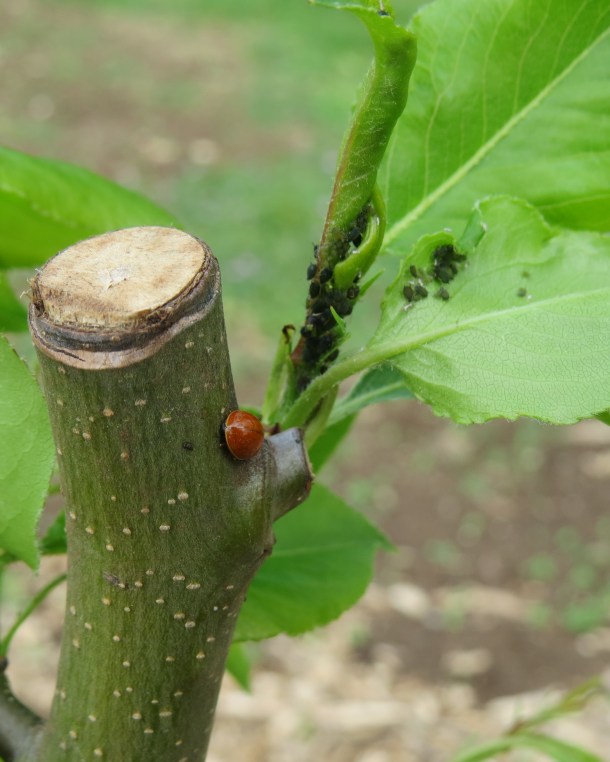
Another environmentally safe control method is to be patient and “let nature take its course.”  Within a very short period of time, where you see aphids, you will also see lady bugs (lady beetles) laying their bright orange eggs on the leaves of infected plants.  The lady bug larva, which looks like a miniature spined alligator, is a voracious consumer of aphids.  Studies have shown that each larva can eat up to 40 aphids in a single hour.  This has earned the larva the name of “aphid wolf.”  Other important beneficial insect predators include soldier bugs, damsel bugs, big-eyed bugs, spiders, assassin bugs, syrphid flies, gall midges, and lacewings.

Above: Ladybug to the Rescue!

Above: Ladybug to the Rescue!

So if you are having problems with aphids and sugar ants, before you get out the chemicals, try some of these low impact methods of aphid control.  Not only will you be able to get aphid damage down to an “acceptable” level, but your biting sugar ant problem will decrease also.

Carolyn

Pictures by Starla