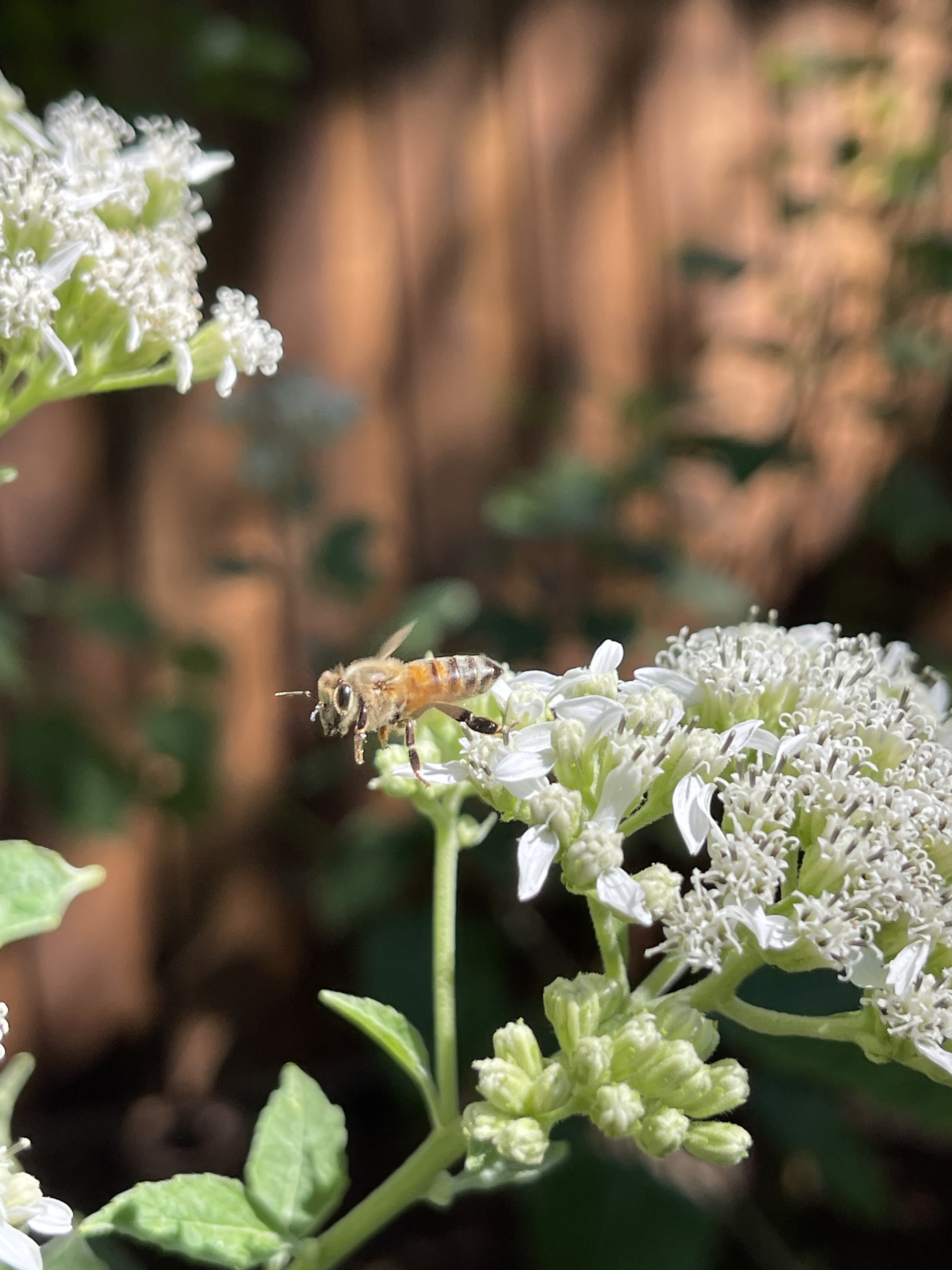
Meet the 2025 Pollinator of the year, the Hoary squash bee.
As much as I love bees, the squash bee has escaped my notice. Thankfully, pollinator.org has selected this bee as its 2025 pollinator of the year.
Honey bees are generalists while squash bees rely almost exclusively on squash and gourd pollen to feed their young. They are expert foragers on the squash blossoms of pumpkins, summer squash, winter squash, zucchini and gourds of the Cucurbita Family.
Squash bees are large and bulky like bumblebees, but are more similar to honeybees in their coloring. Compared to honeybees, they have rounder faces and longer antennae.
Sunrise is the best time to be in our Texas gardens and that’s when you might find a male squash bee darting from squash flower to squash flower in search of mates. The females are busy pollinating and build undergound tunnels to store squash pollen and nectar for their offspring.
Why do we need to focus on pollinators?
Our efforts make a difference, and pollinators need our support. I have read that one in three bites of food can be attributed to the work of our pollinators. There is a lack of interest in backyard biodiversity and planting to provide for pollinators. Miles of boxwood bushes and plastic lawns do nothing for bees or butterflies. Even flowers like periwinkles do not provide pollen, so we need to be more intentional and protective of pollinators and select and provide for them. Doug Tallamy reminds us” plants are not just for decoration, plants are vital ecological entities that do so many things.”
Start small, your backyard can become an oasis for you and our pollinators. If you need help, call a Master Gardener or visit our garden, The Raincatcher’s Garden, at 11001 Midway Road in Dallas. There are many good books and native plant lists available.
Ann Lamb, Dallas County Master Gardener Class of 2005
To learn more about honeybees, one of our favorite pollinators, buzz over these articles.
We are now entering the final month of our year-long journey into the world of honeybees and honey production. Along the way, we’ve attempted to answer the introductory question that started this series…’What’s all the buzz about’?
January began with a brief overview that introduced our readers to some of the topics we would be exploring in 2023. Starting with the “Anatomy of a Honeybee” and “What is Honey?” followed by “The Three Different Types of Honeybees in a Hive” to the “Let’s Dance!” article which explained the purposeful and very necessary “waggle dance” routine performed by worker bees, some amazing information has been shared monthly.
We’ve grown in our understanding of how honey is made, the reason behind the various colors and tastes which ultimately depends on the soil, source and other environmental factors. Hopefully, after reading the article about “Tasting Honey”, you were able to land on a favorite new variety. For me, the most appealing taste profile, at this time, is the earthiness of Black Sage Honey with notes of fruit and pepper. Remember, it’s the one that is harvested only four times per decade!
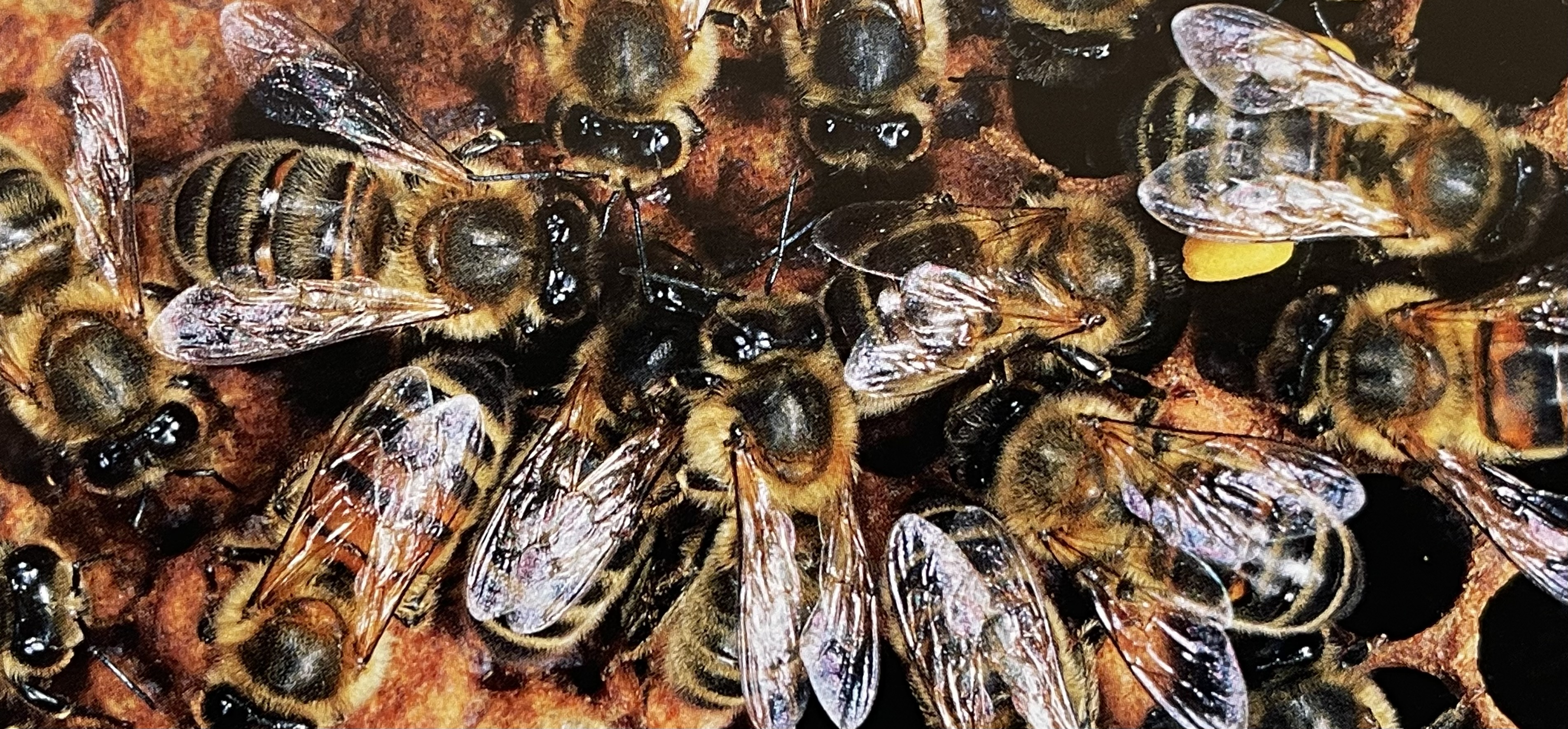
After discovering secrets of the colony, we were amazed at how efficiently these tiny insects perform their specific duties within a brief, but highly productive, lifespan. Think of worker bees as soldiers and the most active bee of their species. Drones are the male population of the honeybees with their only purpose in life being to stay alive long enough to have the chance of breeding with a queen – a process that occurs only once in their life.
Honeybees are fascinating and brilliant creatures. Without them, our world would be a much different place. Consider these numbers: bees are responsible for pollinating about one-sixth of flowering plant species worldwide and approximately 400 different agricultural types of plants. Simply stated, we rely on the pollination efforts of bees (and other animals) to sustain our modern food system.
On a personal note, my appreciation for honeybees has grown immensely. I now approach them more respectfully and welcome their presence in my garden. And I must admit that one of the highlights of spending time with honeybees throughout the year was the absolute joy of teaching my adorable 8-year-old granddaughter how to photograph honeybees with my new iPhone 15 camera.
We talked about how honeybees were in the garden to perform very important tasks and not to sting us. I watched as she carefully and slowly grew in her confidence about approaching the bees as they foraged for nectar and pollen. Observing as she moved gently closer to the bees and with her precious little hands, snapped the button just in time to capture the perfect shot, was an experience I’ll treasure. (Be sure to see her “first honeybee” photograph in the September frame of the movie!)
In closing, I’ve made an important decision regarding my personal relationship with honeybees. Becoming a “beekeeper” is not the right project for me at this season and time of my life. Instead, my desire is to be more intentional about creating specific pollinator-friendly options and opportunities throughout my gardens for the honeybees. Writing about honeybees this year has helped me to discover a longer list of seasonal plants that will be attractive to all pollinators. It’s time for a new journey and I can’t wait to get started!
And finally, the meaning behind the title, “Telling the Bees”, is something I stumbled across while doing research about honeybees. It is an old Western European beekeeping tradition in which bees are told of everything that goes on in their keeper’s family, including births, deaths, illnesses and marriages. Bees are, therefore, treated as extended members of their own family. Beekeepers talk to the bees in calm voices and never use harsh words for fear of upsetting the bees. It is a fascinating story worth reading. Also, click on the link to poems written by John Greenleaf Whittier and Eugene Field entitled “Telling the Bees.”
Here are the two December recipes featuring honey:
In just a few weeks our year-long journey into the world of bees will come to an end. Until then, let’s explore, unarguably, the best part of experiencing honey.
In April of 2014, Joe Field (our location prior to relocating and becoming Raincatcher’s Garden on Midway Road) master gardener volunteers hosted a honey-tasting event along with a fabulous honey-themed lunch. A local beekeeper was our featured speaker. To this day, it has been one of our most successful educational programs. Not only did we learn the ‘proper’ way to taste honey, but the menu was created with those complimentary flavors in mind.
(For a quick glimpse of the menu and other photos from the event, go to the following link)
Our instructor that day shared with us that the composition of honey depends largely on which flowers are visited by the bees when collecting nectar. We should also not forget that plants produce nectar in order to attract pollinators such as honeybees, wasps, moths and bats. Another important fact is that the nectar of each plant species has a different combination of sugar and odor. Together, with the flower’s shape, design and color, this helps to guide the bee from one flower to another of the same kind.
Additionally, it was beneficial to learn that honey’s color, flavor and aroma all derive from the plants pigments and other materials secreted in the nectar. This is what makes honey from each floral source unique. Last month we shared examples of local fall blooming pollinator-friendly plants. Some of the flavor profile descriptions of those flowers can help us to imagine the taste of that particular honey.
Color and Flavor Aster: Water-white to light amber. Spicy overtones, firm, chewy texture. Borage: Pale yellow or water white. Herbal and floral bouquet with hints of cucumber and orange pekoe tea. Sugary aftertaste. Goldenrod: Brilliant amber to a warm golden yellow. Bright, sharp, floral-like flavor with hints of fresh straw. Spicy aftertaste.
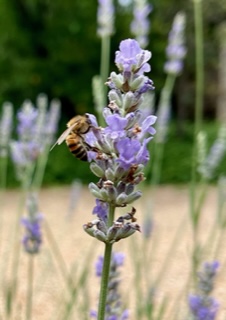
And a few others: Lavender: Light amber. Strong camphor-perfumed taste with sweet tobacco notes. Thyme: Carmel to dark, golden amber or darker. Aromatic, floral, lemony, minty and strikingly sweet.
Honeybees gathering nectar from Lavender blossomsHoneybees gathering nectar from thyme blossoms
Here is a quick overview of how we learned to taste honey. *Tasting honey is an exercise in comparing and contrasting flavors.
*Our taste buds can distinguish between five flavor sensations: sweet, sour/tart, salty, bitter and umami, which is a savory taste. The taste buds for each flavor are located at different areas on the tongue. This is the reason why it is recommended that you move the honey around your mouth as you taste it. Tasting more than one honey at a time gives you a reference point for comparing “tasting notes”.
*Begin with the lightest in color, moving on to medium ambers and then finishing with the darkest. Light-colored honeys typically have a mild flavor, while dark-colored honeys are usually stronger in flavor.
*Take a sip of water in between each sample to clear your palate. Also, a crusty piece of bread and a variety of cheeses can complement the tasting experience.
*To keep it simple and less confusing, start with about five to six different types of honey.
*Start by drizzling a sample of honey onto your tongue and let it melt for a few seconds.
*Spread it around your mouth and consider several questions:
Is it woody, floral, full, light, crisp, buttery, well balanced? Does it have a long finish or an abrupt end? Do you like it or find it unpleasant?
Finally, there is no right or wrong as we each have our own individual taste preferences and predisposition to flavors. Embrace the process of learning how to appreciate honey and celebrate the opportunity to discover the flavors you find the most enjoyable!
FYI…I was intrigued about Goldenrod honey and decided to try to find a source that sells it. That led me to Bee Friends Farm in Michigan. My two 12 oz. bottles should arrive within a few days! Look for an update about the flavor and taste in our December article.
Linda Alexander, Dallas County Master Gardener Class of 2008
For the past few weeks, I’ve been spending countless hours in the garden. It didn’t take long to notice the increased level of honeybee activity occurring from early morning until evening. The bees are everywhere during daylight hours and seem to be buzzing around the flowers with a frenzy in their movements. It is truly fascinating to watch.
Why, I wondered, is fall such a busy time for the bees? One interesting explanation that I stumbled across was that honeybees have switched from needing protein to feed their young to craving carbohydrates before they die later in the season. Seems rather sad but, as we know, the lifespan of a honeybee is relatively short – a few weeks to maybe six months, at the most.
I also discovered that as long as the weather is mild, honeybees will continue to forage throughout the autumn months. During this time, worker bees spend many hours collecting enough nectar (carbohydrates) and pollen (protein) to feed and maintain the colony throughout the winter. Keeping the hive alive during the winter months is a priority. In order for this to happen, worker bees will need to be especially vigorous and healthy.
(NOTE: In the summer months a hive can have about 60,000 bees, but only about 10,000 bees are needed to ensure a colony survives the cold winter weather. As honeybees start preparing for winter, most drones (male honeybees) are evicted from the hive. Since drones have one purpose only – to mate with a queen – when their work is over, out they go.)
As the days grow shorter and colder, the remaining honeybees will form what is referred to as a “winter cluster”. The queen and her brood are kept at the center of this globe-like cluster while worker bees shiver or vibrate their wing muscles, generating enough heat to keep the hive warm in even very cold temperatures. On mild winter days, as we often experience in Zone 8, bees will come out of the hive to dispose of waste products, clean the hive and forage.
However, since there aren’t many options for foraging in the middle of winter, fall nectar and pollen gathering is critical to the hive’s continued survival. We can play an important role in supporting the honeybees during this time by taking a few steps to help them in their work.
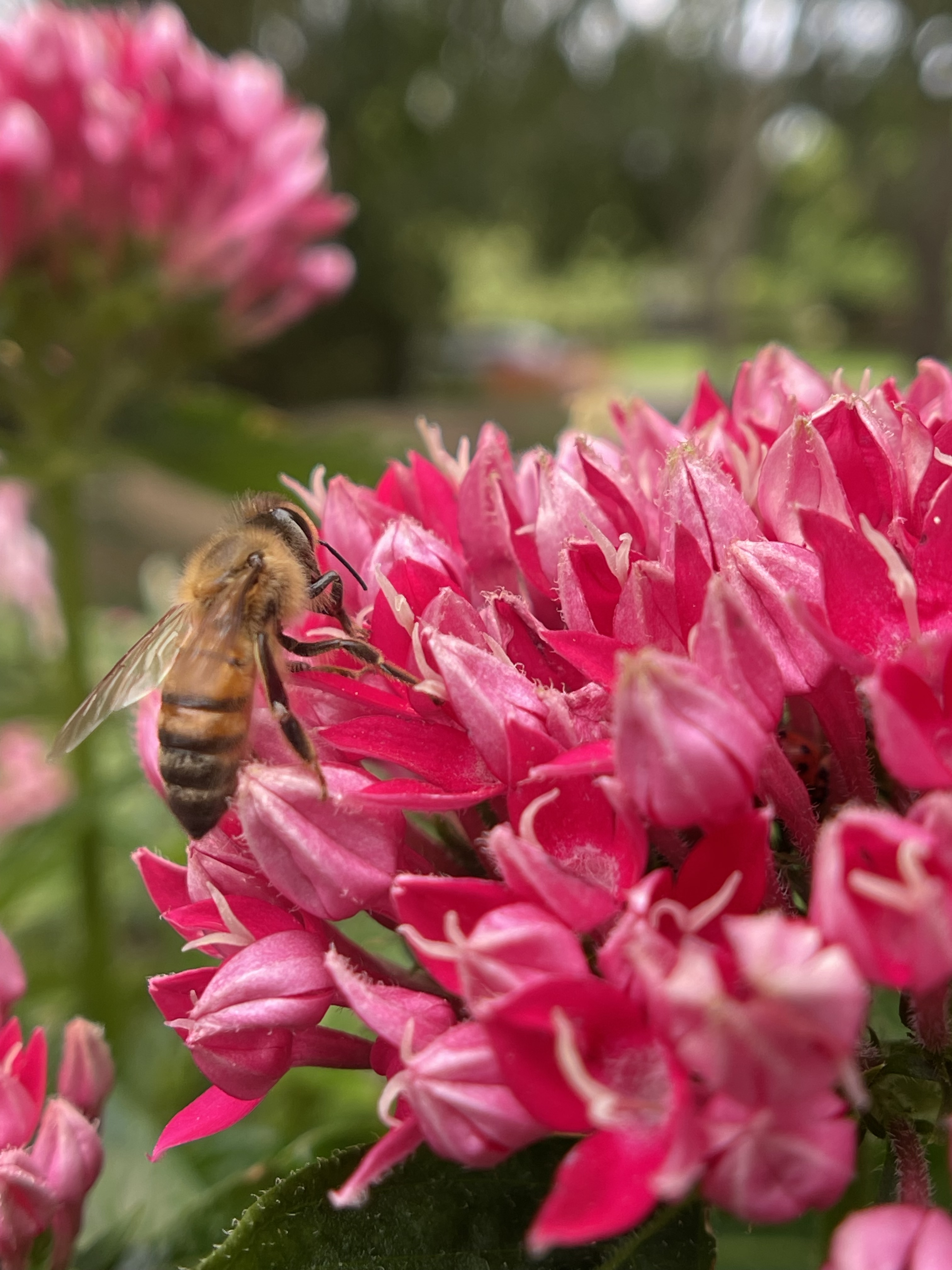
*Plant late blooming plants that provide the nectar and pollen bees need. Some examples include fall asters, borage, calendula, frostweed, goldenrod, hibiscus, pentas, salvia and zinnias. We have pictures of most of these pollinator plants above.
*Plan to leave your basil plants in the ground until the first “cold snap” or freeze. I’ve noticed more honeybees on my fall basil plants than anything else in the garden.
*Provide a fresh water source (shallow container) and add some pebbles or twigs for the bees to land on while drinking.
Black Sage Honey, (Salvia mellifera)
Sometime around the middle of September, while visiting our youngest son and his family, we started a conversation about the different flavors of honey. He wanted to know if I had ever heard of Black Sage Honey. My answer was “yes”, but I had never tasted it. Immediately, he brought out a jar, opened it and, together, we all sampled a delicious, peppery honey that was truly unique.
Later that evening, I did an online search to learn more about “black sage”. Here is a brief summary of what I learned about this amazing plant from Specialty Produce.
“Black Sage is a powerfully fragrant, woody shrub that quickly grows to an average of one meter in height and width. More mature plants can reach up to 1.8 meters. The plant has tiny hairs coating the stems and leaves in a sliver-green fuzz, and flowers that range from white to pale blue or lavender grow in spherical clusters known as whorls, along the square stems. The small, oval, dark-green pebbled leaves can look almost black from a distance, especially during dry conditions, and the stem and whorls harden and turn black at the end of the season – all characteristics believed to have influenced the plant’s name. Black Sage leaves produce a strong, herbal, sometimes minty scent and offer a mildly astringent, herbaceous flavor.”
After learning that black sage is recommended for USDA Zones 8-10, I began searching for a grower. Mountain Valley Growers in Squaw Valley, California had the plants in stock, so my order was quickly placed. I purchased a total of three plants. They arrived on October 20th and, after acclimating for a few days, were put into the ground this week.
New planting of Black Sage. It will receive about six hours of sun followed by dappled shade in the late afternoon.
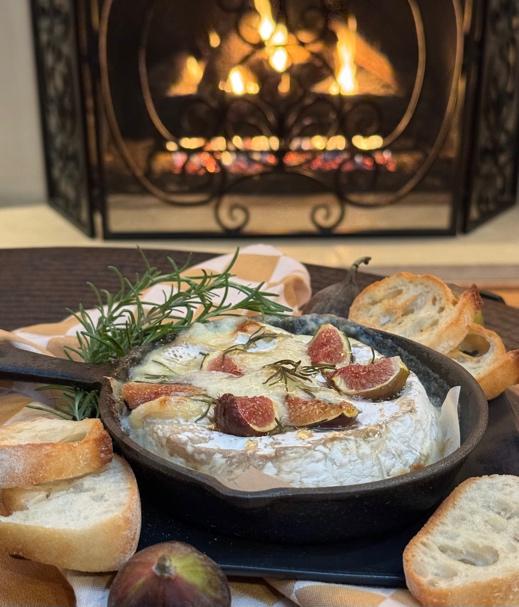
And finally, what’s all the “buzz” about Black Sage Honey? Black sage is native to Southern California and Northern Mexico. It flowers only about every three years. That translates to a very rare honey that is made only about four seasons per decade! Thankfully, I was able to find a jar from Savannah Bee Company and am happy to share this simple recipe with everyone. My recommendation is to experience the wild and earthy taste on its own then decide how you would best enjoy using it. Drizzled over brie cheese and fresh fall figs is my first choice!
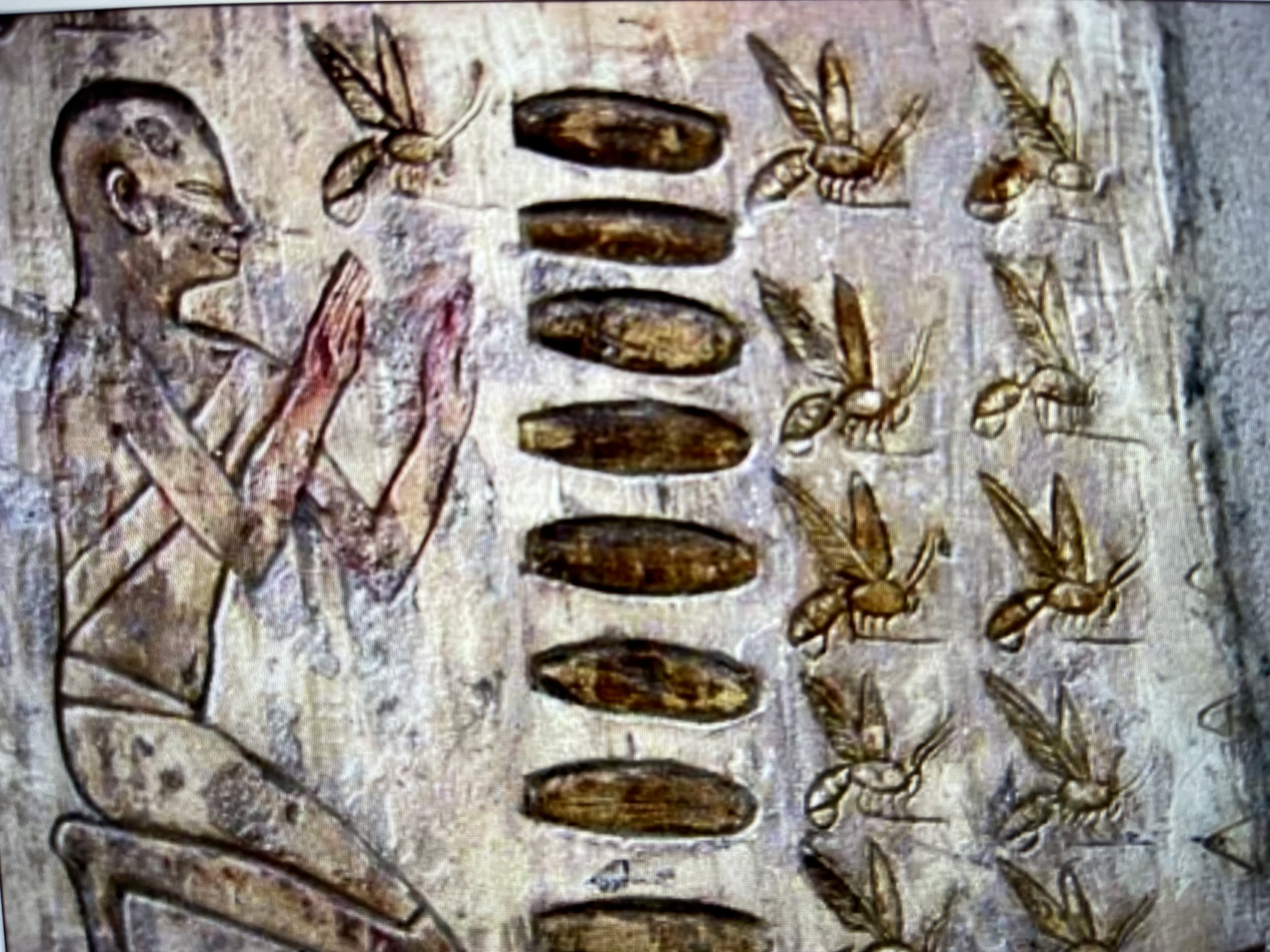
Almost every country on the planet has a story about the relationship between humans and their bees. Let’s cruise through some of the more entertaining facts pertaining to one of the most fascinating insects in the world. Consider how the flowing sweetness of honey has, since ancient times, given us eloquent phrases associated with “honeyed words”. Even bee behavior has been identified with our own in phrases such as a dominate female being referred to as a “queen bee”, or when hard at work it might imply that we are “as busy as a bee”. Such symbolism has its roots in ancient cultures of the world.
Bees in Mythology *San (Bushman) of southern Africa left prehistoric spiritual rock drawings of bees and their nests suggesting that bees had a special importance in the Stone Age. *Prehistoric cave drawings in La Cueva de la Arana in eastern Spain show images of how early humans plundered wild bees’ nests for honey.
*The Myceneans, an indigenous Greek civilization dating back to the 16 th century BC, used images of bees on their beehive shaped tombs. *Ancient Mayas of Mesoamerica kept native stingless bees and celebrated the bee god, Ah Mucan Cab, by downing honey and balche, an alcoholic honey drink. *In 1653, construction workers near the church of Saint-Brice in Tournai discovered over 300 beautiful gold and garnet cloisonne bees in the tomb of Childeric (440-482), king of the Franks. Sadly, in 1831, thieves broke into the library of the Bibliotheque nationale de France, where they were stored, stealing hundreds of pounds of gold artifacts, including Childeric’s treasure. A significant portion was melted down, leaving only two little bees in existence today.
The story of Childeric’s bees made such a strong impression on Napoleon Bonaparte that, ultimately, the bee became the new emblem of the French Empire. Even more specifically, the bee came to represent Napoleon intimately, serving as his personal emblem. He was given the nickname, the Bee. Shortly afterwards, Napoleon’s friend and miniature portraitist, Jean-Baptiste Isabey, took to the task of redesigning Childeric’s bees. His resulting design was immensely handsome. Soon enough it became suitable for fashionable wear, and would come to dominate the interiors, decorative art, fashion and material culture of the Napoleonic court. Even today, the bee emblem is used on French glassware, cutlery, linens, upholstery fabric and cosmetics.
Globally, we continue to celebrate the influence of the honeybee found in themed fabrics, jewelry, paper goods, decorative items and so much more. Looking back across time, it is an enduring reminder of the indelible mark bees have left on mankind. Enjoy these timeless images of the impact honeybees and their beloved honey have in our world today!
September’s featured honey recipe transitions us from a cherished summer fruit…peaches…to some time-honored autumn favorites…pecans and sweet potatoes. Feast on a stack of these warm and lightly spiced pancakes and you’ll be swooning with joy. Just don’t forget the maple syrup!
Sweet Potato Pancakes with Spiced Pecans and Fresh Peach Butter, recipe below
Linda Alexander, Dallas County Master Gardener Class of 2008
Perhaps the first question that comes to mind is if honeycomb is truly edible. The answer is yes but the reason why is worth exploring. Honeycomb is made from beeswax but it’s important to know how it comes into the hive. As we’ve already learned, bees forage for nectar, which is necessary for the development of honey and, therefore, the development of honeycomb.
So, let’s start at the beginning. Bees collect nectar by sucking it up their tongues and storing it in their honey stomach. Once bees have collected a honey stomach full of nectar, they return to the hive. At this point, honeybees begin turning the nectar into honey by passing it through their mouths to the mouths of other worker bees. Each bee chews on it for half an hour before passing it on to the next. Eventually, this process evaporates the nectar and then turns it into honey. Bees consume honey and as they digest it, the honey is converted into wax through a series of glands on the bee’s abdomen. A honeybee has 8 wax-producing glands.
FYI…Bees must consume around 6-8 pounds of honey to produce 1 pound of wax!
The wax enters into the bees’ abdomens as small flakes. But to turn the flakes into beeswax, bees must move the flakes up to their mandibles, or moveable jaws, so they can chew and soften the substance. Bees use one of two methods for transferring the flakes from one place to the next:
1. Another bee removes the scales for them and does the chewing themselves. 2. Using one hind leg, they move the wax scale to the first pair of legs known as forelegs. From the forelegs, bees transfer the scales to the mandibles.
Through the process of chewing and chewing, bees mix enzymes from their salivary secretions which softens the wax flakes until it becomes formable like clay. Once the wax becomes a clay-like material, bees will combine large groupings of the wax together to create the hexagon-shaped honeycomb. Interestingly, this crowding concept also creates the necessary conditions to keep the hive at the right temperature for honeycomb’s survival.
FYI…By crowding together, bees know how to maintain the hive temperature at 95 degrees F – the perfect temperature for manipulating beeswax. Because bees are expert temperature regulators, they will use a fanning motion with their wings to cool the hive on hot days. Maintaining this temperature is also essential for keeping their Queen warm on cold days.
In summary, bees work tirelessly to produce their honeycombs. Fortunately for us, we get to enjoy the fruits of their labor. Honeycomb is an excellent source of antioxidants and carbohydrates. It also has trace amounts of nutrients. Enjoy eating it raw in the form of delicious honeycomb honey as well as a sweetener in homemade desserts. Sprinkle small pieces across a favorite salad or alongside fruit, cheese or as a centerpiece for your next charcuterie board.
Linda Alexander, Dallas County Master Gardener Class of 2008
Strawberry, Peaches and Honeycomb Salad and the recipe right here.
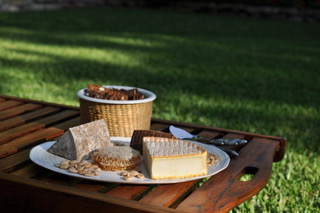
In 2016, a wonderful new cookbook was published by the Dallas County Master Gardener Association. The title was ‘A Year on the Plate’. One of the cookbook committees’ favorite photographs was taken late in the afternoon with long shadows stretching across the yard as sunlight drifted slowly behind the trees. The dish to be photographed was from the honey section of the book. It was a charcuterie board featuring an assortment of salty cheeses and nuts with a lovely round honeycomb serving as the main attraction. Looking through several options, we were thrilled with the dreamy look of one particular photograph that captured the essence of our star ingredient.
Since that day over seven years ago every imaginable type of charcuterie board has been created. And, as you might have guessed, each one is almost always designed around a honeycomb. Carefully cut and oozing with sweet honey, it is a magical gift of nature that comes from honeybees. During the months of July and August, we’ll take a look inside the hive to discover some of the most amazing facts about honeycomb construction and why it is considered to be the building block of the hive.
What is honeycomb? Honeycomb is a cluster of repeating hexagonal beeswax cells made by honeybees and used for raising brood and storing honey and pollen. Honeycombs store honey because honey is valuable to bees. It feeds their young and sustains the hive.
Why are honeycombs constructed using the hexagonal shape? First consider spheres, pentagons and octagons. All of these produce gaps. Bees are efficient creatures so anything with gaps isn’t the answer. As it turns out, there are only three geometrical figures with equal sides that can fit together on a flat surface without leaving gaps: equilateral triangles, squares and hexagons. So, which one is best? It’s a very old question and one that a Roman soldier/scholar/writer named Marcus Terentius Varro proposed an answer to in 36 B.C. Ever since then, Varro’s answer has been referred to as “The Honeybee Conjecture”. Simply stated, he thought that a honeycomb built of hexagons could hold more honey and, maybe, hexagons require less building wax. Why is the issue of wax important? It takes thousands and thousands of bee hours, tens of thousands of flights back and forth to the foraging source to gather nectar from countless flowers just to start the process of building a honeycomb. Is it, therefore, reasonable to assume that bees want a tight, secure structure that is as simple to build as possible?
As was eventually determined, compactness matters. The more compact your structure, the less wax needed to construct the honeycomb. Wax is a precious material. A honeybee must consume about eight ounces of honey to produce a single ounce of wax. It is an accepted fact that the hexagon shape uses the least amount of wax. Additionally, years and years of research have demonstrated that honeybees use the shape of their bodies as rulers to build each cell exactly the same. Even Charles Darwin himself once wrote, the honeycomb is a masterpiece of engineering. It is “absolutely perfect in economizing labor and wax.”
Linda Alexander, Dallas County Master Gardener Class of 2008
As humans, we live in an information age where advancing technology continues to take us to new horizons. Amazingly, for as long as honeybees have been on the planet, their highly effective way of communicating has remained the same. Survival in the world of honeybees is dependent upon good communication. Let’s look at how the concept of ‘moving in the right direction’ plays a major role in the process. An Australian zoologist named Karl van Frisch (1886-1982) measured aspects of honeybees’ dances by artificially manipulating forage sources. He described two types: the round dance and the waggle (or figure-eight) dance. Scout bees returning from foraging flights immediately attract the attention of other bees which huddle close to monitor the scout’s movements in the darkness. A short Q & A will provide a better understanding of these astonishing dances and how bees use them to share precise information with the hive. Why do bees dance? To communicate the location of food. Foraging is a highly organized operation. When a forager bee finds a particularly good source of nectar, she returns to the hive and directs others to the source. Specific instructions for the location are communicated through the patterns of the dance. How do bees learn to dance? Bees need “tutors”. In order to learn the dances correctly, they must follow other experienced dancers. The concept of social learning ultimately shapes honeybee signaling giving them the ability to use a complex form of spatial referential communication. What is learned from the dances? In a strangely mysterious way, dancing communicates the direction, distance and quality of a resource to nestmates by encoding celestial cues, retinal optic flow and relative food value into motion and sound within the nest. If you thought it was just a colony of bees buzzing around in the hive, it is scientific fact that these curious movements (bee language) are used to manage the work of the hive. “Busy as a bee” is truly something to be admired. How is the waggle dance explained? Outgoing forager bees gather in a specific part of the hive to watch returning foragers perform the dance. The dancer walks across the comb in the pattern of a figure eight, waggling her abdomen back and forth as she moves through the straight portion of the pattern. The direction she faces while waggling charts an angle in relation to the sun. Other foragers use this information to help navigate their way to the source. The more she waggles, the better the foraging in this area. Also, the longer the dance, the farther the distance from the hive.
What determines how much the scouter bee moves her abdomen? The fervor with which she vibrates her abdomen during the dance, the greater the richness of the forage source.
Linda Alexander, Dallas County Master Gardener Class of 2008
In 1971 singer-songwriter Van Morrison released his album Tupelo Honey. Shortly thereafter, the album reached number 27 on the Billboard charts. As a result, the name and brand of Tupelo honey reached a national audience. Then in 1996 Tupelo honey once again gained recognition in the media spotlight with the release of the major motion picture Ulee’s Gold starring Peter Fonda. Not only did Fonda win a Golden Globe for his performance in the film, but Tupelo honey also earned the distinction of being known as the Queen of the Honey World.
Tupelo honey is light golden amber with a greenish cast. The first taste is of cinnamon with a tinge of anise. That gives way to a whisper of jasmine and something citrusy like tangerine rind.
Tupelo honey is unique for its unusually high fructose to glucose ratio. Because of this ratio, raw Tupelo honey is very slow to, and rarely ever crystallizes. The higher fructose to glucose ratio also makes Tupelo honey one of the sweeter honey options.
Considered by many to be the most expensive honey in America, it seems strangely odd that the best Tupelo honey producing region in the world is the Florida panhandle along the Appalachicola, Chipola and Choctahatichie River systems of creeks and backwaters. It comes from the nectar of the White Ogeechee Tupelo trees. The Tupelo tree, also known as the swamp gum tree, is abundant in only a few places in the country including Northwestern Florida, Southern Georgia and Louisiana. Beekeepers load their beehives on barges and float them in the swamp for the 3-week blooming period, being careful to avoid the alligators lurking in those waters. The little flowers are very delicate and can be easily destroyed by high winds or severe rain. This is why the demand for Tupelo honey will always exceed the supply!
Tupelo BlossomTupelo Trees
Linda Alexander, Dallas County Master Gardener Class of 2008
Take a quick look at the six jars of honey shown above. What did you notice? If the first thing that caught your eye were the different colors, then a brief description of honey’s relative visual properties might provide some insightful information. And, yes, it’s true that most of us generally choose honey based on color.
Honey Colors
The U.S. Department of Agriculture classifies commercial honey (the jars you typically find in the grocery store) into 7 color categories:
*Water White (0 mm – 8 mm) (Colorless and transparent)
*Extra White (8 mm – 17 mm) (Very light-yellow tint while remaining transparent)
*White (17 mm – 34 mm) (Slightly more yellow/very light amber, also transparent)
*Extra Light Amber (34 mm – 50 mm) (Transparent with a light orange/amber hue)
*Light Amber (50 mm – 85 mm) (Deeper orange /amber hue, not fully transparent)
*Amber (85 mm – 114mm) (Deep orange color and not transparent)
*Dark Amber (114 mm – 140 mm) (Very dark and opaque, referred to as “motor oil black”)
How Honey Color is Measured
The color of honey is typically measured using a continuous scale known as the Pfund scale of measurement. The scale consists of a glass wedge that varies in its color from lightest to darkest amber. The honey to be evaluated is poured into another wedge-shaped container and then the color is compared with the amber scale. The place where the color of the honey matches closest to the scale is then marked as the result. The final measurement is thus given in a number ranging from 0 to 140 mm (according to the scale length where the match occurs).
What Determines Color?
The color of honey is determined by its floral source, or blossoms of the nectar, and mineral content. Honeybees forage for both nectar and pollen. Nectar is the bee’s source of energy while pollen provides protein and other nutrients. As the bee forages, pollen grains collect on its head. The bee then uses its front legs to transfer the pollen to the pollen baskets located on its hind legs. Bees mix dry pollen with nectar to compact the pollen in the pollen basket. Honey, therefore, gets its color from the pollen that a hive gathers to make it.
Light colored honeys like citrus, rosemary, lavender, eucalyptus and thyme contain high amounts of calcium. Darker honeys contain higher amounts of potassium, chlorine, sulfur, sodium, iron, manganese and magnesium. Iron is what gives buckwheat honey its deep brown color.
Lighter-colored honeys generally have a milder flavor but with a pronounced floral aroma often accompanied by herbal, spice, vanilla, butterscotch or other enticing flavor notes. As the honey gets darker in color, the aroma and taste become more distinctive. All honey tends to deepen in color as it ages, but this change does not affect its flavor.
Finally, it is important to keep in mind that soil, climate, water, wind and sun all contribute to every honey’s sensory attributes, including color, aroma and flavor. This unpredictable mosaic of natural conditions is a gentle reminder of the ever-changing profile of varietal honey. Clover honey from this year may surprise your taste buds with a slightly different flavor profile in the future.
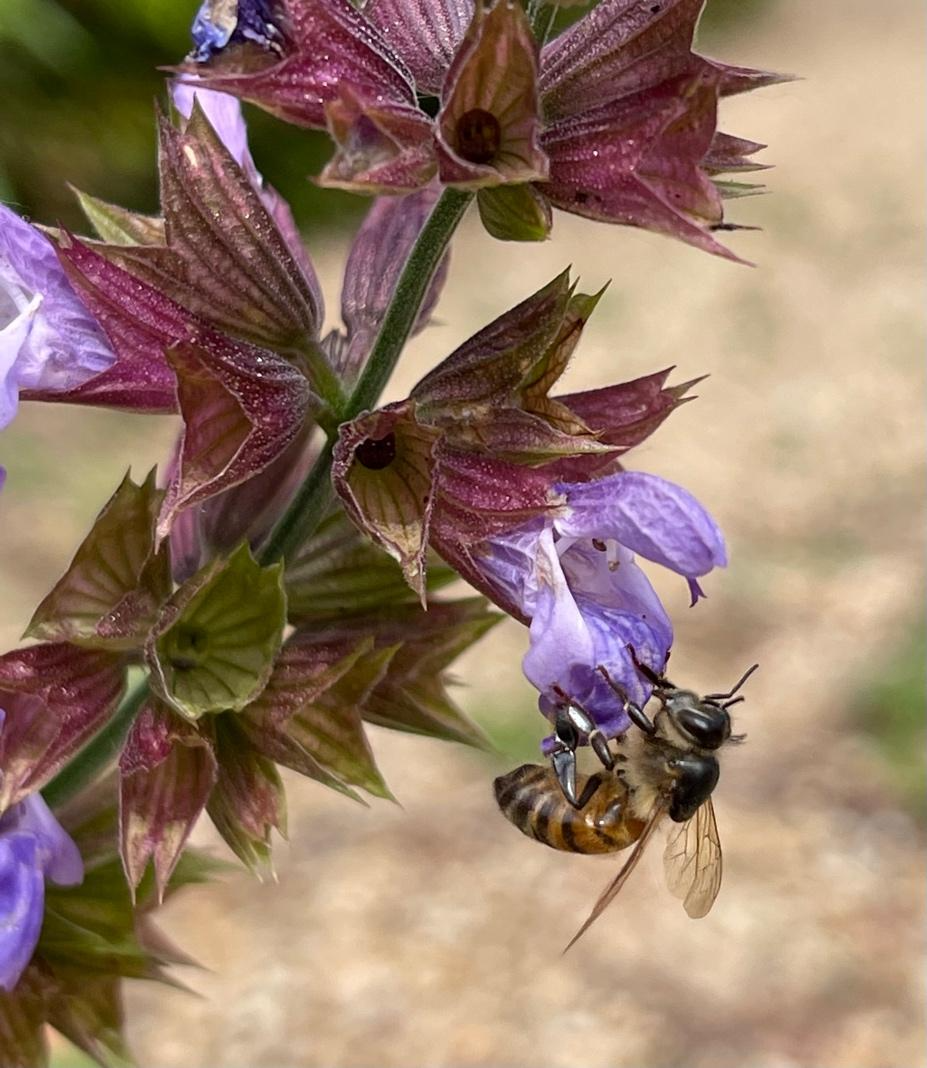
(Honeybee gathering nectar from Sage blossoms)
Examples of light honey floral sources:
*Sage
*Clover
*Fireweed
*Cotton
*Acacia
*Alfalfa
*Apple Blossom
*Blackberry
*Blueberry
*Palmetto
*Tupelo
Examples of dark honey floral sources:
*Buckwheat
*Avocado
*Chestnut
*Dandelion
*Huckleberry
*Manuka
*Tulip
Linda Alexander, Dallas County Master Gardener Class of 2008



















 DALLAS GARDEN BUZZ