Move over husband Mike. I’m in love, but I can’t spell—or pronounce–his name.
To bring you up to date, the old 8,000 square foot garden on Joe Field Road is now moved lock, stock, compost pile, tomato support, and rototiller to a fabulous new location at Midway Hills Christian Church, Royal Lane and Midway Road. We also have a new name, Raincatcher’s Garden of Midway Hills, an Earth-Kind ® Water/Wise Demonstration Garden, a collaboration of the Dallas County Master Gardener Association, Texas A&M AgriLife Extension, and Midway Hills Christian Church.

Midway Hills Christian Church, Site of our New Garden
MHCC has generously offered us a 100’x300’ field for a new garden and plans are hatching. Just like butterflies will—we hope—this spring.
We brainstormed the components that we wanted to bring (or not) to the new garden: vegetables, an education garden, and a wildlife habitat. And some new things we wanted to feature, like urban trees and turf. But probably tops on people’s list was a butterfly garden.
Which brings me to my new love: skippers, brushfoots (not “feet), whites, sulphurs, blues, hairstreaks, and swallowtails. I’d like to learn to be a lepidopterist, but I’ve got to set some time aside to learn to roll out that moniker.
Diving into Butterflies of Texas by Geyata Ajilvsgi and the Dallas County Lepidopterist’s Society website maintained by Dallas butterfly expert Dale Clark was absolutely fascinating.

Variegated Fritillary (Euptoieta claudia)
I learned if you want to attract grass skippers, you need an abundance of host grasses like bluestem and side-oats gramma in your garden.
Most gardeners know to plant dill, fennel, parsley, and rue for swallowtail caterpillars, but they also have a hankering for citrus, celery and Queen Anne’s Lace.
We’re familiar with the Pirinae family of sulphur’s and white’s passion for broccoli and cabbage. But the Coliadinae family of whites and sulphurs pine more for senna, marigolds, clover, and false indigo for host plants.
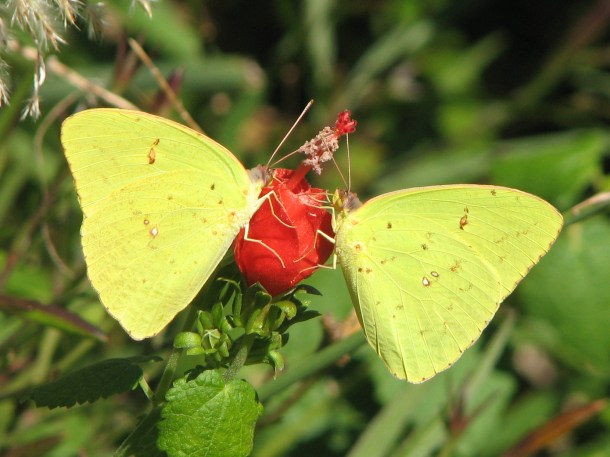
Cloudless Sulphur Butterflies on Turk’s Cap, Photo by Janet D. Smith
Hairstreaks look for oaks, mistletoe, Texas bluebonnets and okra. Blues are thrilled with frostweed, lima and garden beans, and snouts want sugarberry and net-leaf hackberry. Fritillaries swoon for maypop and passionvines, monarchs for milkweed.
Brushfoots remind me of a 17-year-old football player. They’ll clean out your garden “refrigerator” of almost everything. Wildflowers to thistles to American elm, to frogfruit are on the host plant menu.
As we’re planning the garden, there’s more to think about than host and nectar plants. You want your plants in full sun (more nectar), have enough water to prevent wilting (nectar stops with inadequate moisture), use favorite colors of purple, pink, yellow and white, and include a variety of bloom shapes. Some little guys forego the nectar plants and pull over for old fruit, a fermented sugar mixture, or a damp salt and sand mixture for amino acids. Rocks and logs in the sun give a spot for basking. Old logs and brush provide Red Admirals and Mourning Cloaks a spot for hibernating.
The monarch has gotten a lot of press lately concerning the declining amount of milkweed necessary for its caterpillars. We plan on having a Monarch Waystation, based on recommendations from Monarch Watch, filled with native and tropical milkweed for the trip north and favorite nectar plants for the fall migration to Mexico.
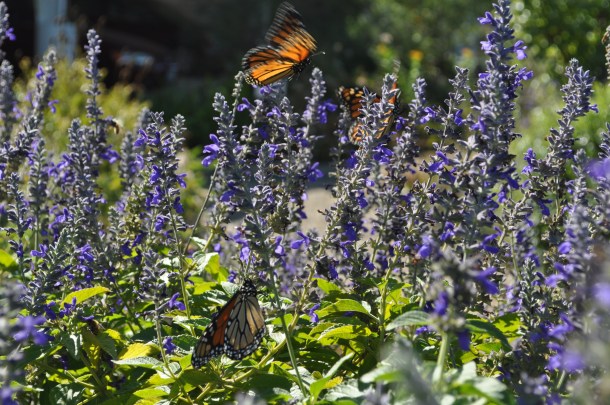
Monarch Butterflies Nectaring on Blue Salvia at our Old Location
As our plans take place, we are looking forward to late spring and summer, and we hope, a large garden full of fluttering beauties.
Elizabeth
Pictures by Starla and Ann and Janet
More about Monarchs!





 DALLAS GARDEN BUZZ