As humans, we live in an information age where advancing technology continues
to take us to new horizons. Amazingly, for as long as honeybees have been on the
planet, their highly effective way of communicating has remained the same.
Survival in the world of honeybees is dependent upon good communication. Let’s
look at how the concept of ‘moving in the right direction’ plays a major role in the
process.
An Australian zoologist named Karl van Frisch (1886-1982) measured aspects of
honeybees’ dances by artificially manipulating forage sources. He described two
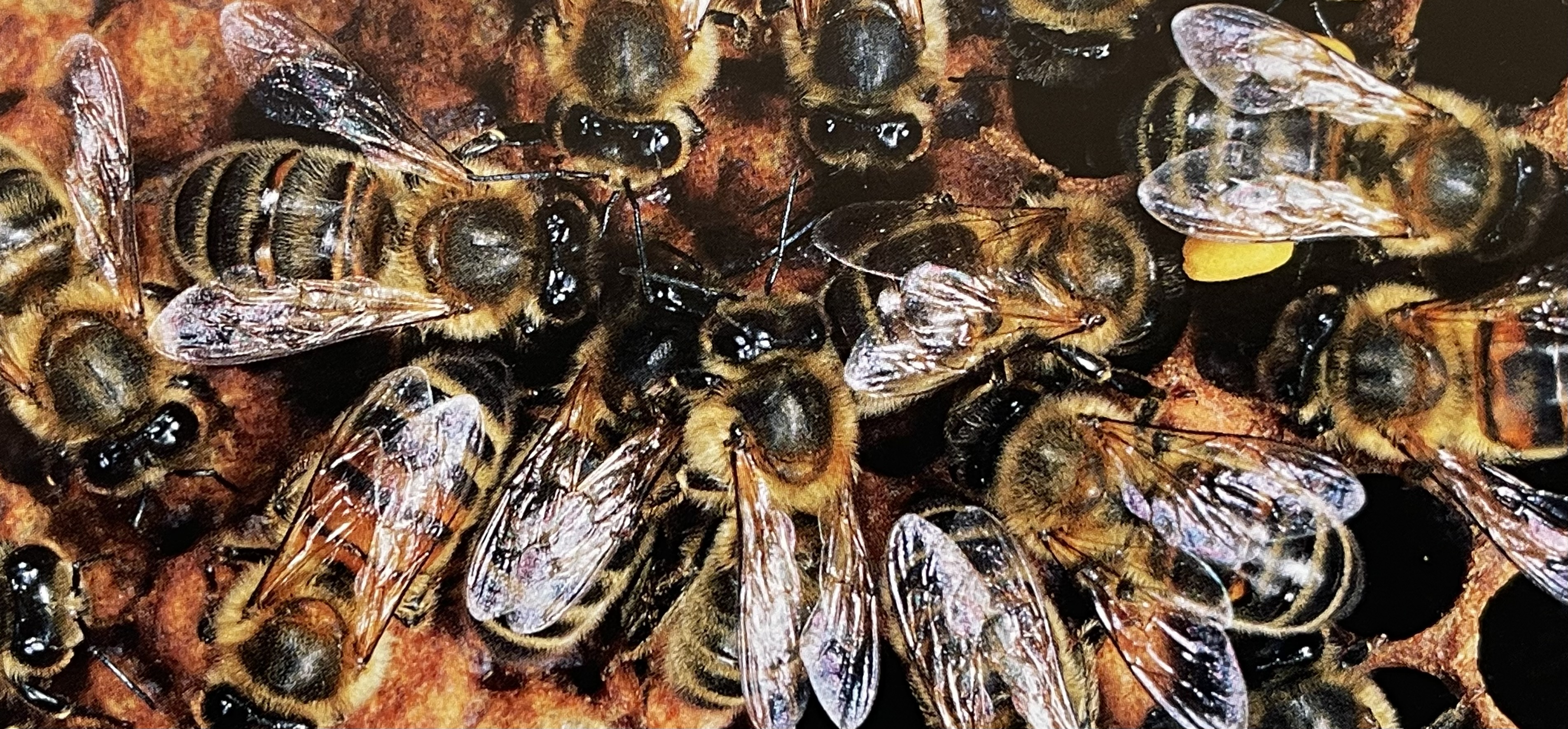
types: the round dance and the waggle (or figure-eight) dance. Scout bees
returning from foraging flights immediately attract the attention of other bees
which huddle close to monitor the scout’s movements in the darkness.
A short Q & A will provide a better understanding of these astonishing dances and
how bees use them to share precise information with the hive.
Why do bees dance?
To communicate the location of food. Foraging is a highly organized operation.
When a forager bee finds a particularly good source of nectar, she returns to the
hive and directs others to the source. Specific instructions for the location are
communicated through the patterns of the dance.
How do bees learn to dance?
Bees need “tutors”. In order to learn the dances correctly, they must follow other
experienced dancers. The concept of social learning ultimately shapes honeybee signaling giving them the ability to use a complex form of spatial referential
communication.
What is learned from the dances?
In a strangely mysterious way, dancing communicates the direction, distance and
quality of a resource to nestmates by encoding celestial cues, retinal optic flow
and relative food value into motion and sound within the nest. If you thought it
was just a colony of bees buzzing around in the hive, it is scientific fact that these
curious movements (bee language) are used to manage the work of the hive.
“Busy as a bee” is truly something to be admired.
How is the waggle dance explained?
Outgoing forager bees gather in a specific part of the hive to watch returning
foragers perform the dance. The dancer walks across the comb in the pattern of a
figure eight, waggling her abdomen back and forth as she moves through the
straight portion of the pattern. The direction she faces while waggling charts an
angle in relation to the sun. Other foragers use this information to help navigate
their way to the source. The more she waggles, the better the foraging in this
area. Also, the longer the dance, the farther the distance from the hive.

What determines how much the scouter bee moves her abdomen?
The fervor with which she vibrates her abdomen during the dance, the greater
the richness of the forage source.
Linda Alexander, Dallas County Master Gardener Class of 2008



 DALLAS GARDEN BUZZ